



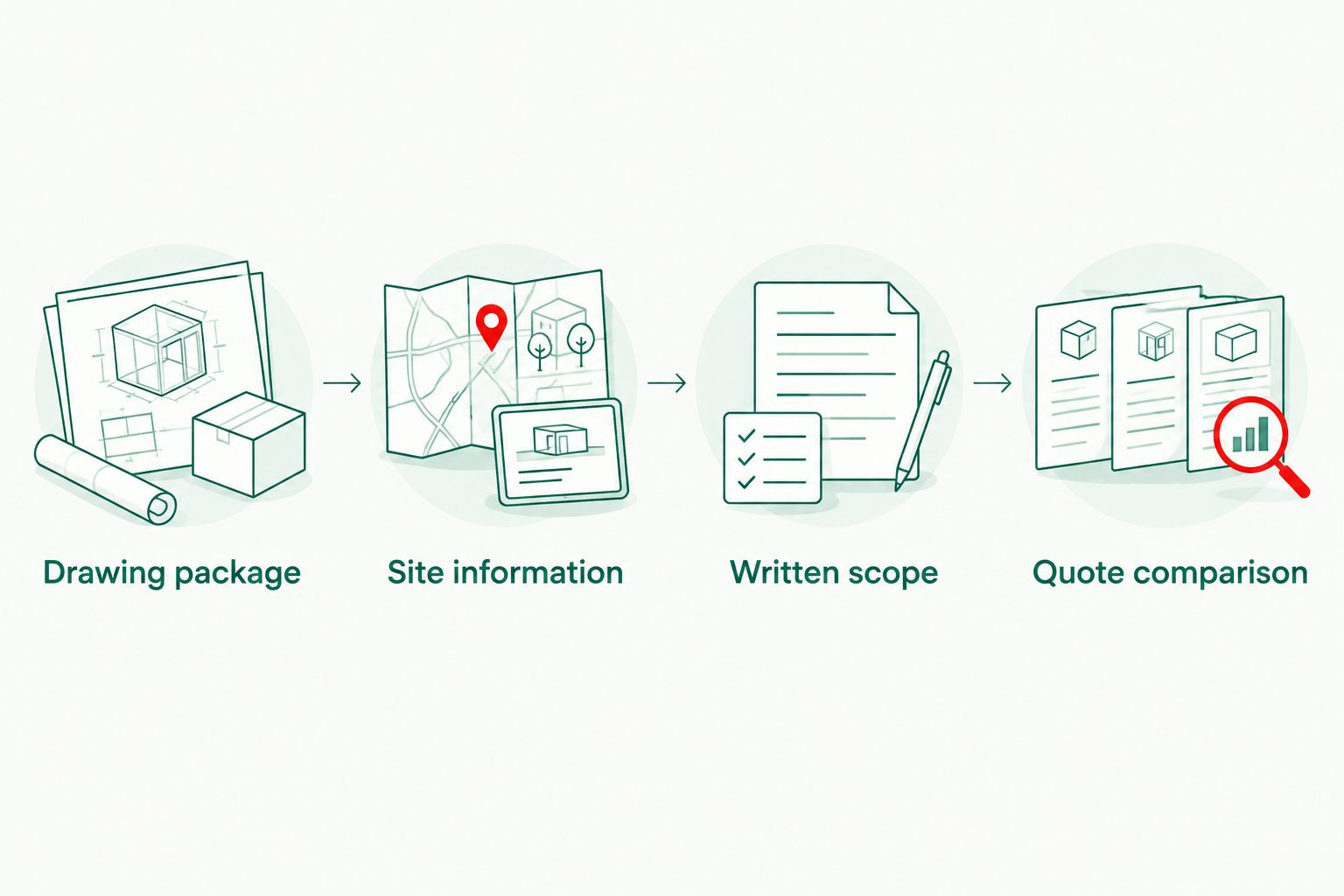
Instead of manually explaining your house plan to every builder, move from house plan to builder quotes with one version-controlled package containing the drawings, site information and written scope. Send the same package to each builder, record questions centrally, then compare inclusions and unresolved assumptions before choosing who progresses.
- Australianhousedesigns offers ready-made house plans and custom drafting; builder quotes still need a site-specific scope.
- The house plan to builder quotes workflow starts with matching drawings, site information and written inclusions.
- Use preliminary estimates for design decisions, not as substitutes for detailed builder quotes.
- Issue every material clarification to all quoting builders so the comparison stays consistent.
Why this matters
A floor plan shows room arrangements, but it does not necessarily define excavation, structural requirements, finishes or service connections. If builders fill those gaps differently, their quotes describe different jobs.
Australianhousedesigns is best for buyers seeking ready-made house plans or custom home-design drafting. The Australianhousedesigns house design service supplies the design starting point; your quote package must also explain the site and intended construction scope.
For a 2026 build, separate design selection from quote readiness. A layout you like is not automatically a documented scope a builder can price without qualifications.
Before you start
- Gather the documents: obtain the current drawings, property details, available survey and soil information, and your written requirements. Check that you have permission to share the drawing files for quoting.
- Nominate the decision-maker: choose who answers builder questions, approves design changes and maintains the document register. Give builders one contact rather than conflicting instructions from several people.
- Check the hidden gotcha: establish what the drawing package actually contains. Preview drawings, site-specific documentation and approval documents serve different purposes; do not assume one package covers every stage.
You do not need a particular app. A shared folder, email and spreadsheet are enough if you control versions and keep a written record.
Choose the right quote stage
Match the request to the information you can supply. An early estimate helps test a design direction; a detailed quote supports a closer comparison once the scope is defined.
| Quote stage | Best for | Advantage | Limitation |
|---|---|---|---|
| Preliminary estimate | Buyers testing a layout before completing documentation | Identifies broad scope questions early | Depends heavily on assumptions and is not a substitute for a detailed quote |
| Detailed builder quote | Buyers comparing a defined design and specification | Makes inclusions and exclusions easier to examine | Still needs careful checking for allowances, qualifications and missing work |
Ask builders to identify the stage of their response. A document headed quote still needs scrutiny if key work remains undefined.
Drawing package
- Select the reference design. Confirm the intended layout, storeys, garage arrangement and outdoor areas before requesting comparable quotes. List unresolved design decisions rather than letting each builder choose an answer.
- Create a document register. Use the fields Document name, Revision, Issue date and Status. These are suggested spreadsheet headings, not settings in a particular software platform.
- Separate current and superseded files. Put only current documents in the folder you issue. Keep old drawings elsewhere, and attach a dated drawing list to the request.
Check dimensions from the written drawing information, not from a screenshot. On a correctly printed drawing at 1:100 scale, 10 mm represents 1 m and 50 mm represents 5 m; resizing the print breaks that relationship.
Ask the designer to resolve inconsistent dimensions before issuing the package. A builder should not have to choose between conflicting floor plans and elevations.
Expected result: every builder receives the same identifiable drawing set, and you can state exactly which revision each response should cover.
Site and specification schedule
- Attach the site information you hold. Include the survey, soil report and relevant property constraints where available. Record missing information explicitly; never present an unknown site condition as confirmed.
- Define the included work. Create scope headings for site works, structure, external finishes, internal finishes, fixtures, services and external works. Under each heading, state what you require and what remains undecided.
- Assign responsibility for gaps. Ask who will obtain outstanding reports, arrange specialist input and coordinate any required approvals. Record the answer rather than assuming the builder or designer has included it.
For example, “bathroom included” leaves important decisions open. Describe the required fixtures, tiling extent and fittings, or ask the builder to state the allowance and its basis without treating that allowance as a final selection.
Site information deserves the same attention as finishes. Access, ground conditions and levels affect the work being quoted. Use the house plan to soil test and site survey workflow to organise those inputs before asking builders to remove site assumptions.
Expected result: the scope explains the house and the site, with named responsibility for unresolved items.
Builder request and clarification log
- Write one request covering the package. State the property, document revisions, required response date and scope boundaries. Ask builders to identify exclusions, assumptions, allowances and documents they still need.
- Request a consistent response structure. Ask each builder to address the same scope headings. Also request the quote validity period, proposed delivery approach and the basis of any indicative construction programme.
- Maintain a clarification log. Use Question, Answer, Affected document and Issued to builders as headings. Send material answers to every participating builder, even when only one builder asked the question.
Distinguish clarification from change. Explaining an existing requirement clarifies the package; adding a retaining wall changes it. Record either outcome, but issue revised documents when the actual scope changes.
Keep phone discussions in the written record. Send a short email confirming the agreed interpretation, then ask the builder to correct any misunderstanding before relying on it.
Label your 2026 request with its actual issue date. The year alone does not distinguish an early package from a later revision.
Expected result: builders can respond against a common brief, and you have a traceable record of the information supplied.
Quote comparison
- Check document alignment first. Confirm that each response refers to the current drawings and specification. Resolve an outdated revision before comparing the quote with other submissions.
- Build a scope matrix. Put scope headings down the rows and builders across the columns. Mark each item as included, excluded, allowance or clarification required, using the builder’s actual wording as supporting notes.
- Close material gaps in writing. Ask builders to confirm missing work and clarify qualifications. Keep unresolved differences visible rather than making your own adjustment and treating it as the builder’s commitment.
Useful comparison rows include excavation, spoil removal, retaining work, service connections, floor finishes, painting, driveway work and approval responsibilities. Include only rows relevant to your project; a long template is not evidence that those items apply.
Compare the defined scope before judging the headline figure. A quote that excludes required work is not directly comparable with a quote that includes it.
Save the original response alongside each clarification. Preserve the difference between what a builder initially offered and what the builder later confirmed.
Expected result: you can explain the substantive differences between builders without relying on assumptions about what their quotes include.
Reissue quotes whenever the house plan changes
A revised layout needs a controlled update, not another attachment dropped into an old email chain. The same applies when a site report changes the construction assumptions or a finish selection changes the scope.
Create a fresh revision entry, describe the changes and identify the documents being replaced. Ask each builder to acknowledge receipt and state whether the changes affect the response already supplied.
For a 2026 revision cycle, use a change register with these fields:
- Change description: what changed and why.
- Affected documents: the drawings, reports or schedules replaced.
- Builder response: whether the previous quote remains applicable or needs revision.
- Outstanding decision: anything still awaiting confirmation.
Do not overwrite the earlier comparison. Save a new comparison against the revised package so you can see which changes prompted a different response.
Best for: buyers developing a design while builder discussions continue. The advantage is a clear decision trail; the limitation is that repeated changes require further review and leave earlier quotes unsuitable for direct comparison.
Check builder fit alongside the paperwork
Scope alignment does not establish whether a builder suits your project. When choosing a custom home builder, examine relevant project experience, communication and how the builder explains exclusions, not just the returned quote.
Keep Australian checks separate from overseas examples. Verify licensing or registration through the relevant state or territory authority, and confirm the insurance requirements applicable to your project. Do not apply another jurisdiction’s contracting rules to an Australian build.
Ask who will supervise the work, who handles variations and how unresolved design questions reach the designer. Request project examples relevant to your site and house type rather than accepting unrelated experience as equivalent.
Australianhousedesigns offers house design and drafting services; assess the proposed builder’s construction responsibilities separately. Confirm those responsibilities in the documents you are being asked to accept.
A 2026 builder shortlist should record both scope completeness and these checks. Good communication does not replace clear documentation, and detailed paperwork does not replace checking the builder.
Troubleshooting
Builders return very different scopes
Check what each builder received and which assumptions each response uses. Reissue missing documents or a clarification schedule, then ask builders to identify which parts of their responses change.
Do not force different submissions into a single comparison by guessing what omitted work involves.
A builder will not quote from the supplied plans
Ask which documents are missing and whether the builder can provide a preliminary estimate instead. A refusal to give a detailed quote can reflect an incomplete package; it does not by itself establish a problem with the design.
Site works remain unresolved
Identify the missing information behind the qualification. Obtain the relevant site evidence and specialist input, then ask the builder to revise the affected scope rather than simply remove the qualification.
The quote refers to an old revision
Send the current document register and ask for written confirmation against it. Keep the quote marked as superseded until the builder confirms its status.
Verbal promises contradict the quote
Ask the builder to incorporate the promise into the written scope or issue a written clarification. Do not rely on your meeting notes alone as evidence that the builder has accepted an obligation.
Customise your workflow
For a duplex, separate shared work from work specific to each dwelling. For an acreage home, define access and service responsibilities. For a narrow block, document access constraints and site assumptions rather than relying on a generic description.
Australianhousedesigns house plans and custom drafting provide alternative design starting points, but neither removes the need to check site suitability. Keep design changes, specialist input and builder clarifications connected through the same register.
Before a 2026 contract decision, review the outstanding-items list. Take unresolved contract terms to an appropriately qualified adviser rather than treating the quote comparison as contract advice.
FAQ
How do I go from a house plan to builder quotes?
Issue the same current drawings, site information and written scope to each builder. Collect exclusions and assumptions in a comparison matrix, then resolve material gaps in writing.
Can I get builder quotes from a floor plan alone?
You can ask for a preliminary estimate from a floor plan, but the response will depend on assumptions. Ask the builder what additional documentation is needed for a detailed quote.
Do I need council approval before asking builders to quote?
Approval is not always required before an initial estimate. Ask the builder which approval documents are needed for the quote stage, and confirm your project’s approval pathway with the relevant authority or certifier.
Should every builder receive the same documents?
Yes, every builder should receive the same current package and material clarifications. Different revisions or scope instructions prevent a like-for-like comparison.
What should I do when a builder excludes site works?
Ask the builder to identify the excluded work and the information needed to define it. Keep the exclusion visible until responsibility and scope are confirmed in writing.
Does buying a ready-made house plan make it ready for quoting?
Not automatically: check the package contents and the builder’s documentation requirements. Site-specific information and a written specification still need attention.
What happens to builder quotes when I change the plan?
Ask every quoting builder to review the revised package and confirm whether the previous quote remains applicable. Do not assume a layout or specification change has no effect.
One last thing
The most revealing quote question is: what have you assumed that is not written in the package? Add the answer to your clarification log and share any material scope decision with every quoting builder.