



Instead of manually forwarding house plans between your designer, consultants and building certifier, set up a coordinated handover with a confirmed approval pathway, a document register and one current drawing set. For a plan from Australianhousedesigns, start by asking your appointed certifier which site-specific drawings, reports and application documents the project requires.
- Australianhousedesigns supplies ready-made house plans and custom drafting; confirm site-specific submission requirements with your certifier.
- Your house plan building certifier handover needs coordinated drawings, supporting reports and a clear revision record.
- Confirm the approval pathway before commissioning the submission package.
- Send revised drawings with a change summary, not as unexplained replacement attachments.
Why this matters
A floor plan explains the layout. A building approval submission must also address the proposed building on its actual site, supported by the documentation required for that project and jurisdiction. Buying a house plan is not the same as obtaining permission to build it.
For a 2026 project, confirm the applicable requirements with the relevant authority and your appointed certifier rather than copying another homeowner's document list. Approval names, appointment rules and submission processes differ across Australia.
Australianhousedesigns is best for buyers seeking ready-made house plans or custom home-design drafting. Keep that design role separate from the certifier's assessment role: ask who prepares each document, who checks coordination and who submits the application.
Before you start
- Project information: Have the property address, land identification, available survey information, proposed dwelling type and your current drawings together. Record unresolved site questions rather than treating assumptions as confirmed facts.
- Contacts and authority: Identify your designer, proposed certifier and whoever will lodge the application. Confirm local appointment requirements and ask what owner authorisation or other documents are needed before submission.
- The easily missed gotcha: A generic plan does not establish that the design fits your land or satisfies its approval conditions. Confirm the planning position, site constraints and required supporting reports before treating the drawings as a submission package.
You need a written requirements list, not just a conversation saying the plans look suitable. If a report or specialist input is outstanding, assign an owner and record whether it prevents the application from proceeding.
Approval pathway and responsibility register
Confirm the route before preparing the package
- Identify the jurisdiction. Give the proposed certifier the property address, land details and an accurate description of the work. Explain whether the proposal is a new house, secondary dwelling, duplex or another type of development.
- Confirm the approval pathway. Ask which planning and building approvals apply, which authority handles each stage and what must happen before the building application can be assessed. Do not assume the certifier replaces every other approval authority.
- Confirm the appointment process. Ask who can appoint the certifier, what documentation formalises the appointment and which services the appointment covers. Establish the correct process before treating an informal discussion as an engagement.
- Create a responsibility register. Use the headings Document, Prepared by, Checked by, Submitted by and Status in your own spreadsheet. These are suggested register headings, not labels from a particular application portal.
- Record the assessment basis. Ask the certifier to confirm the applicable requirements for your 2026 submission, including any transition provisions relevant to the project. Pass that information to the people preparing the drawings and reports.
Expected result: You know the application route, the responsible parties and the information needed before the package can be assessed. Keep unresolved questions visible; an unanswered question is not an approval.
Coordinated drawing package
Match the selected plan to the site
Your choice between a ready-made plan and custom drafting changes the design starting point, not the need for site-specific coordination. Australianhousedesigns offers both approaches; select the approach around the work your site and brief require.
| Design approach | Best for | Advantage | Limitation before certification |
|---|---|---|---|
| Ready-made house plan | Buyers who have found a layout that suits their brief | Gives you an existing design to assess against the site | The selected layout does not establish site suitability or approval |
| Custom home-design drafting | Buyers whose brief needs a tailored layout | Lets the design respond to the stated project requirements | A tailored design still needs supporting information and assessment |
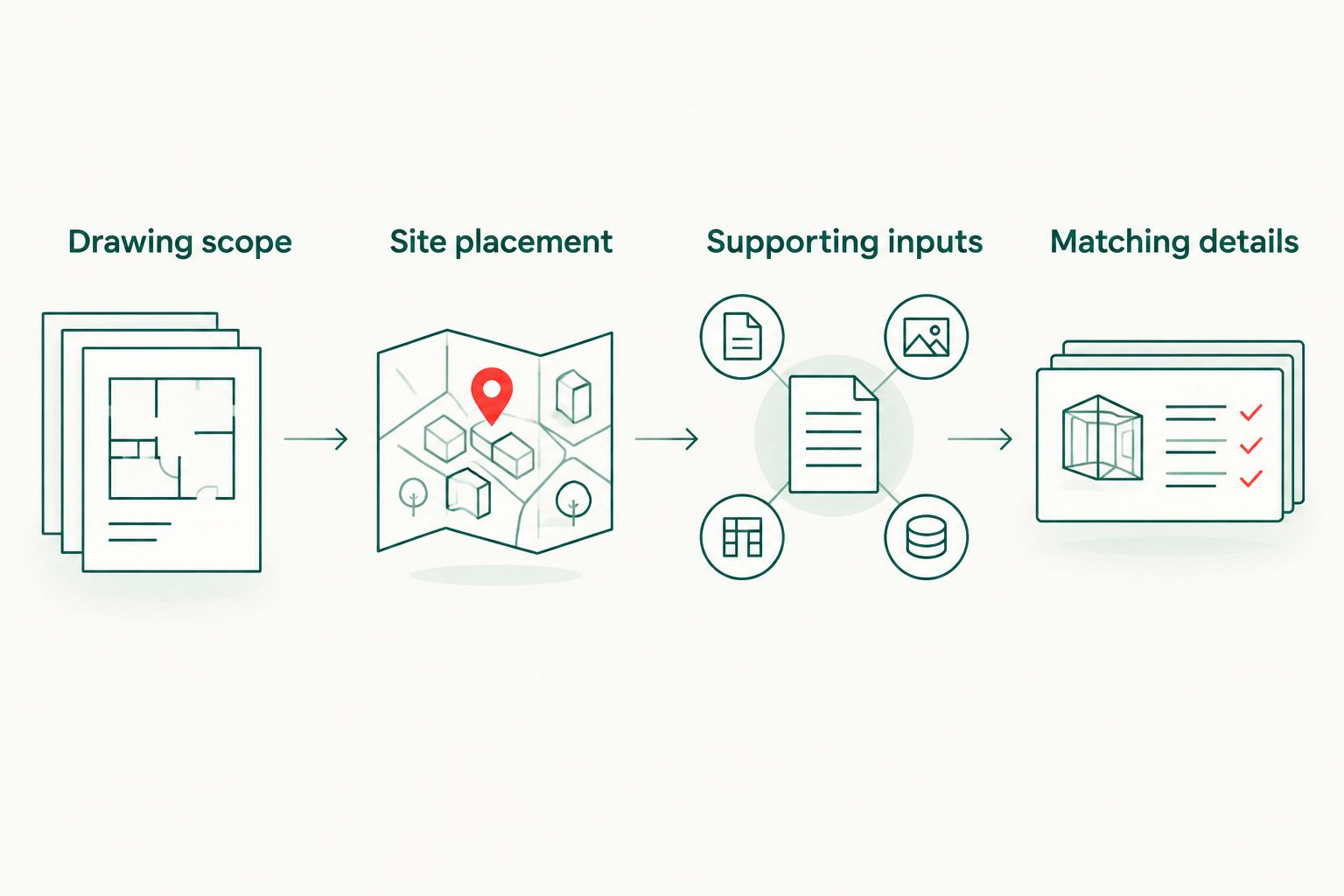
- Confirm the drawing scope. Ask your designer what the selected package contains and compare it with the certifier's written requirements. Establish who will prepare anything outside that scope.
- Check site placement. Have the proposed building position checked against the survey and relevant site restrictions. Address boundaries, access, levels, easements and other identified constraints rather than relying on the floor plan alone.
- Coordinate supporting inputs. Obtain the engineering, energy assessment and other specialist documentation required for your project. Have the designer and relevant consultants resolve differences between their documents.
- Check matching details. Compare the property identification, building footprint, openings, floor levels and revision references across the package. Flag discrepancies to the document authors instead of editing professional reports yourself.
- List unresolved decisions. Record any items still affecting the design, such as a changed window arrangement or an unresolved drainage proposal. Ask the certifier which items must be settled before lodgement.
Expected result: The drawings describe the same building on the same site, and the supporting documents relate to that proposal.
Do not use an attractive presentation drawing as a substitute for missing technical information. Ask the person responsible for the submission drawings to close the gap, and keep preliminary material clearly distinguished from the set intended for assessment.
Submission folder and document register
Give the certifier an identifiable assessment set
- Confirm the delivery method. Ask whether the application goes through a government portal, the certifier's system or another agreed channel. Obtain the actual submission instructions before uploading or emailing files.
- Create one submission folder. For a 2026 application, identify the folder by project address, purpose and issue date. Separate working files from the documents you intend the certifier to assess.
- Populate the document register. List each filename, document title, author, revision, issue date and purpose. Use consistent status labels such as Working, For assessment and Superseded in your own register.
- Check the files. Open every document from the submission folder. Confirm that pages are present, text is readable, the intended revision is included and the file format meets the recipient's requirements.
- Send a short covering note. Identify the project, explain what you are submitting and list any agreed exclusions or outstanding items. Attach the register or include it through the required submission channel.
- Confirm receipt. Ask for the application or project reference and confirmation that the files were received. Keep that acknowledgement with the submitted set.
Expected result: You and the certifier can identify exactly which documents were submitted and when. Receipt confirms delivery, not approval.
Assessment responses and revised submissions
Close each request against a named document
- Record each request separately. Copy the certifier's request accurately into a response register. Add the responsible person, required action, affected documents and response status.
- Clarify uncertain requests. Ask the certifier what information is needed before asking a consultant to change a document. Do not turn an unclear comment into an assumed design instruction.
- Coordinate the response. Send each request to the relevant author and identify any linked changes. A layout adjustment must be checked for consequences in supporting drawings and reports.
- Collect revised documents. Ask each author to issue an identifiable revision. Update the document register and remove superseded files from the next submission folder without deleting the project history.
- Submit a response summary. Against each request, identify the revised document and where the response appears. Explicitly identify anything still outstanding.
- Check the decision documents. When an approval is issued, read its conditions and identify the documents it references. Confirm the next required steps before work begins.
Expected result: Every assessment request has a traceable response, and the decision relates to an identifiable drawing set. A revised drawing is not approved merely because it has been sent.
When the house plan changes after submission
Use a controlled change process whenever the submitted design changes. Do not quietly replace an attachment or assume that a builder's marked-up copy updates the application.
For a change to your 2026 proposal, send the certifier a clear description of what is changing and ask what assessment or approval action is required. The correct route depends on the change, the existing approval and the jurisdiction.
Follow this sequence:
- Describe the change: State the proposed difference and identify the affected drawings.
- Check dependencies: Ask the relevant document authors whether engineering, energy assessment or other supporting information needs updating.
- Confirm the process: Obtain the certifier's direction on how to submit the change and whether another authority must be involved.
- Issue the coordinated revision: Send the changed documents with a register and change summary.
- Distribute the accepted set: Once the required decision is received, make sure the builder and relevant consultants have the correct documents and conditions.
Expected result: A design change follows an agreed assessment route instead of creating competing versions on site. Retain the earlier issue as a record, but clearly mark it as superseded.
Troubleshooting
The certifier says the package is incomplete
Request an itemised list of missing information and assign each item to its author. Separate missing drawings from missing reports, application forms and owner authorisations; sending the same incomplete bundle again does not answer the request.
The drawings and engineering show different details
Ask the designer and engineer to resolve the discrepancy together. Record which documents will change, then submit the coordinated revisions rather than asking the certifier to choose between conflicting details.
Nobody knows which revision is current
Stop distributing loose attachments and reconcile the document register against the latest submission acknowledgement. Issue a corrected register, identify superseded files and ask recipients to confirm which set they hold.
A late site constraint changes the layout
Return the constraint to the designer and relevant consultant before updating the application. Ask the certifier which documents and approvals the resulting change affects; do not treat a floor-plan edit as an isolated task.
The builder has a different set from the approved documents
Compare the builder's issue with the documents referenced by the approval and its conditions. Resolve discrepancies with the responsible parties before affected work proceeds, and distribute the correct set with a clear issue record.
Customise your workflow
For a straightforward project, keep the register simple enough to maintain. For a project with several consultants, nominate a document coordinator and require changes to pass through that person before submission.
If you are arranging the design and consultants yourself, use the custom home design guide for owner-builders to organise the wider brief. Keep the certifier handover as a defined stage within that project, not an informal exchange after design decisions are finished.
When discussing Australianhousedesigns house plans or custom drafting, ask which documents the service will provide and which require separate appointments. Confirm scope before commissioning work; do not assume a design package includes every submission document.
FAQ
How do I send my house plan to a building certifier?
Confirm the certifier's submission requirements, then send a coordinated drawing set, required supporting documents and a document register through the agreed channel. Identify the revision of every document and retain the receipt.
Can a ready-made house plan go straight to a building certifier?
A ready-made house plan must be checked against the site's requirements and the certifier's document list before it is treated as a submission package. Ask your designer who will prepare the site-specific drawings and any missing information.
Does a building certifier replace planning approval?
Do not treat building certification as a substitute for any required planning approval. Confirm the applicable pathway and responsible authorities for the property's jurisdiction before preparing the application.
Who should coordinate the designer and building certifier?
Nominate a project contact to coordinate documents and responses, while confirming who is authorised to appoint the certifier and lodge the application. Record those responsibilities rather than assuming the designer or builder handles everything.
What happens if I change my house plan after submission?
Tell the certifier what is changing and ask which assessment or approval process applies. Coordinate affected drawings and reports before submitting the revision, and obtain the required decision before affected work proceeds.
What should I check before lodging house plans in 2026?
Confirm the approval pathway, applicable requirements and project-specific document list with the relevant authority and appointed certifier. Check that the drawings, reports and application details describe the same proposal.
Does sending revised plans mean they are approved?
No, submitting revised plans does not establish approval. Check the issued decision, its conditions and the documents it references before distributing a set for the next stage.
One last thing
The approval document and the drawing set belong together. Store the decision, conditions and referenced documents as one controlled package, then make sure the people carrying out the work receive that package rather than an unlabelled collection of plans.